
You probably already know that what you put on your skin matters. But what about what you put on your nails? Most people treat their manicure as a purely aesthetic choice, but the products you use, and the ritual itself, have a measurable impact on your health and your state of mind.
The clean beauty conversation has grown beyond skincare and makeup. In 2026, more people are asking harder questions about nail polish: What’s actually in this bottle? Is it safe to breathe in? What happens when it sits on my nails for two weeks? These are the right questions, and the answers point toward a more intentional approach to your nail routine.
Think of your manicure not as a cosmetic afterthought but as a weekly or bi-weekly wellness ritual. When you approach it that way, the ingredients stop being a footnote and start being the whole point.
Why Your Nail Polish Ingredients Are a Wellness Issue
Your Nails Absorb More Than You Think
There is a common misconception that nails act as a sealed barrier. In reality, your nail plate is semi-permeable. Chemicals in nail polish can be absorbed through the nail bed and surrounding skin, particularly the cuticle area, which is rich in blood vessels. A 2015 study published in Environment International found that triphenyl phosphate (TPHP), a plasticizer used in many conventional nail polishes, was detected in the urine of participants within hours of applying polish.
That is not a minor footnote. It is a reason to read the label.
Conventional polishes can contain a range of chemicals that raise concern when absorbed repeatedly over time. The most discussed include formaldehyde (a known carcinogen used as a hardener), toluene (a solvent linked to neurological effects), dibutyl phthalate (a plasticizer associated with hormonal disruption), and camphor (which can cause nausea and dizziness in concentrated doses). These are sometimes called the “toxic trio” or “toxic four” depending on the formulation.
Non-toxic nail polish removes these ingredients by design. Formulas labeled 10-free, 12-free, or higher are skipping more of these chemicals in every coat.
Salon Air Quality Is a Real Concern
If you get your nails done in a conventional salon, you have probably noticed the chemical smell the moment you walk in. That is not just paint drying. It is a mix of acetone, formaldehyde, methyl methacrylate (MMA), and other volatile organic compounds (VOCs) off-gassing into the air.
According to the National Institute for Occupational Safety and Health (NIOSH), nail salon workers face elevated exposure to VOCs that have been linked to respiratory issues, skin sensitization, and in some cases, reproductive harm with prolonged occupational exposure. A clean nail salon in NYC ventilates properly, uses non-toxic products, and limits the number of harsh chemicals in the space. The difference in air quality is something you can feel in your lungs after a session.
The Ritual Side of It: Why the Manicure Is Genuinely Good for You
Repetitive, Sensory Activities Lower Cortisol
There is real science behind why a manicure feels so restorative. Repetitive, focused activities — things like filing, buffing, or slowly applying polish — activate what researchers call the “relaxation response,” a physiological state that lowers heart rate and cortisol, the body’s primary stress hormone. A 2018 review in the Journal of Health Psychology found that grooming rituals, including self-care routines involving touch, contributed to reduced anxiety and improved mood.
You are not being indulgent when you take 30 minutes to do your nails. You are giving your nervous system a break.
Touch also plays a role. When someone else works on your hands during a professional manicure, the physical contact itself triggers the release of oxytocin. This is the same reason massages feel so effective beyond the physical relief.
Predictable Rituals Build a Sense of Control
When your schedule feels chaotic, small rituals carry significant psychological weight. Having a regular nail routine — whether weekly at home or monthly at a salon — gives you a predictable, low-stakes thing to look forward to. Behavioral psychologists refer to this as “ritual anchoring,” using consistent, sensory routines to create a sense of stability.
The color you pick matters too. Color psychology research shows that warm reds and deep berries are associated with confidence, soft neutrals with calm, and bright shades with social energy. Choosing your polish is a small act of self-expression that connects you to your mood and your intentions for the week ahead.
Non-toxic products make that ritual feel even better. When you know your polish is free of harmful ingredients, you remove the low-level anxiety that can come with knowing you are using something questionable on your body.
Building a Non-Toxic Nail Routine at Home
Start With What You Are Removing
Before you add anything new, take stock of what you are currently using. Check your existing polishes and base coats against a list of ingredients to avoid: formaldehyde, formaldehyde resin, dibutyl phthalate, toluene, camphor, TPHP, xylene, and ethyl tosylamide. If you are unsure, the Environmental Working Group’s Skin Deep database is a free resource for checking specific product safety scores.
The Order Matters
- Prep: Gently push back cuticles with a clean wooden stick after a warm soak. Skip the aggressive cutting, which creates micro-openings for potential irritants.
- Base coat: This is your protective layer and the product most directly in contact with your nail bed. Choose a clean, non-toxic base coat.
- Color: Two thin coats in a well-ventilated room.
- Top coat: Seals everything in and extends wear so you need fewer re-applications and less exposure overall.
- Nourish: After your polish is fully dry, apply a cuticle oil. Jojoba and vitamin E are two ingredients that absorb easily and support nail flexibility.
Frequently Asked Questions
Is non-toxic nail polish as long-lasting as regular nail polish?
Yes, in most cases. Non-toxic formulas have come a long way in 2026. With a quality base coat and top coat, you can expect comparable wear time to conventional polish. The biggest factor is proper nail prep, not the formula itself.
Can non-toxic nail polish cause allergies?
Some people are sensitive to specific ingredients found even in cleaner formulas, such as certain resins or colorants. If you have experienced reactions to nail polish before, patch testing on one nail first is a smart approach. Checking ingredient lists carefully will help you identify what to avoid.
Does “vegan” nail polish mean the same thing as non-toxic?
Not necessarily. Vegan means no animal-derived ingredients. Non-toxic refers to the absence of specific harmful chemicals. A polish can be vegan but still contain synthetic chemicals of concern. The best option is a formula that is both vegan and free from harmful chemicals.
How often should I let my nails breathe between manicures?
Taking a break of a few days every four to six weeks allows your natural nail plate to rehydrate and recover. During that time, a nourishing nail serum or cuticle oil can support recovery. This is less about the polish “suffocating” your nails and more about giving your nail bed a reset from the drying effects of polish remover.
What should I look for in a non-toxic nail polish brand?
Look for transparency about what is free from the formula (10-free or higher is a meaningful marker), ingredient lists that are publicly available, and cruelty-free or vegan certifications if those values matter to you. Brands willing to show their full ingredient lists are generally more trustworthy than those that lead only with marketing claims.
Make Your Manicure Work for You
Your nail routine is a small window into how you treat yourself. When you choose non-toxic products, you are making a quiet decision to take your health seriously, even in the places most people overlook. And when you build that routine into a real ritual, you give yourself something that is both grounding and genuinely restorative.
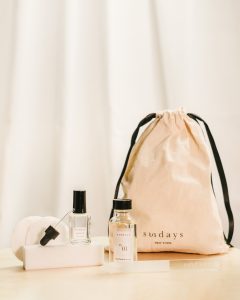
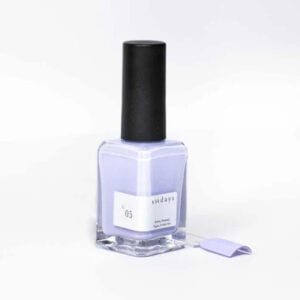
Dear Sundays is built around exactly this idea. Every formula is vegan, cruelty-free, and made without the harmful chemicals that have long been standard in the industry. Whether you are building an at-home non-toxic nail care routine or looking for a cleaner in-person experience, they have created products and a studio space designed to make your manicure something you feel good about from start to finish.
Ready to get started? Book a clean beauty nail service at the sundays NYC salon or shop the full non-toxic nail polish collection to build your ritual at home.