
You have the polish, the top coat, and a solid playlist. But you also have a nail salon two blocks away that you have been meaning to try. If you care about clean beauty, the choice between doing your nails at home and booking a professional service is not as simple as convenience versus results. There are real ingredient, air quality, and experience tradeoffs worth understanding.
New York City has more nail salons per square mile than almost any other city in the world. But “nail salon” covers an enormous range. A standard walk-in spot operating on conventional products and a clean beauty studio using non-toxic formulas are two very different environments, and the gap matters if your health is part of your beauty equation.
Here is what you need to know to make the right call for you.
The At-Home Manicure: Where Clean Beauty Starts
Full Control Over Every Product
The clearest advantage of doing your nails at home is that you control every single thing that touches your hands. You choose the base coat, the color, the top coat, and the remover. You know exactly what is in each bottle because you researched it. For clean beauty enthusiasts, this level of oversight is genuinely satisfying.
You also control the environment. Your bathroom or kitchen table is not filled with acetone vapor. There are no acrylic powders in the air. If you open a window and work in a well-ventilated space, you are keeping your inhalation exposure very low compared to a busy conventional salon.
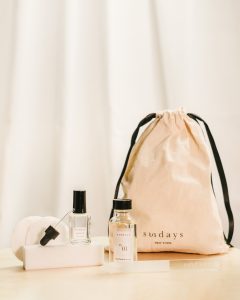
The at-home approach is also the more economical choice for maintenance between professional appointments. A quality non-toxic nail kit gives you everything you need to do a clean, polished manicure on your own schedule without compromising on ingredients.
The Real Limitations
Honesty matters here. Unless you have practiced extensively, your dominant hand will always look slightly less even than your non-dominant hand. Precision near the cuticle line, consistent coat thickness, and streak-free application are skills that take time to develop.
At-home manicures also tend to chip faster if your prep work is not airtight. Proper dehydration of the nail plate, correct base coat application, and sealing the free edge of each nail with top coat are steps that professionals do automatically and that many DIYers skip.
The NYC Nail Salon Experience: What You Need to Assess
Ventilation and Air Quality
New York State passed updated ventilation requirements for nail salons in 2015 following investigations into worker health, but compliance varies. According to the New York Committee for Occupational Safety and Health (NYCOSH), inadequate ventilation remains one of the most persistent issues in the city’s nail salon industry, even a decade after regulatory attention.
When you walk into any nail salon, you should be able to breathe easily. If you notice a strong chemical smell, your eyes water, or you leave with a headache, those are meaningful signals about the air quality in that space. Ask about ventilation directly before you book.
Products and Ingredients
This is the non-negotiable for clean beauty clients. Before you book, ask specifically what nail polish brands the salon uses. Many salons that market themselves as “natural” or “eco-friendly” still use polish lines that contain TPHP, formaldehyde resin, or other chemicals of concern.
Questions worth asking before your appointment:
- What nail polish lines do you use, and are they available to review?
- Are your gel services UV-cured or LED-cured? (LED cures faster with lower UV exposure)
- What remover do you use, and is acetone-free removal available?
- Are your tools sterilized between clients using an autoclave or disposable implements?
Sanitation Standards
Sanitation is a separate issue from clean beauty but equally important. Nail tools that are not properly sterilized between clients can transmit nail fungus, bacteria, and in rare cases, bloodborne pathogens if the skin is nicked. Autoclave sterilization (using steam under pressure) is the gold standard.
Reputable clean beauty salons will be transparent about their sanitation protocols because it is part of their brand promise.
What Makes a Nail Salon a Clean Beauty Salon
The Clean Salon Checklist
- Uses polish lines that are at minimum 10-free (free from formaldehyde, formaldehyde resin, dibutyl phthalate, toluene, camphor, TPHP, xylene, ethyl tosylamide, parabens, and acetone)
- Properly ventilated workspace, not just a fan on the table
- Sterilized or single-use tools for every client
- Transparent about product ingredients on request
- Fragrance and chemical load in the space is minimal
- Staff who can discuss products knowledgeably
A 2021 survey by the Environmental Defense Fund found that over 70 percent of nail salon products sampled contained at least one chemical not listed on the label. This is why knowing the specific brands a salon uses, rather than relying on their general marketing, is essential.
How Dear Sundays’ NYC Studio Fits Into This
Dear Sundays offers what very few nail studios in New York City do: a fully clean beauty experience in a professional setting. The studio uses the brand’s own non-toxic, vegan, cruelty-free formulas, which means you know exactly what products are touching your nails. There is no translation gap between the brand’s clean beauty standards and what you receive in the chair.
The experience is designed for people who want the technical quality of a professional manicure in NYC without the chemical exposure that typically comes with it. If you have been DIYing your nails specifically because you do not trust what conventional salons use, Dear Sundays’ NYC salon offers a real alternative.
So: Salon or At Home?
The honest answer is that neither option is categorically better. They serve different needs.
Choose At-Home When
- You have a well-stocked kit of non-toxic nail products you trust
- You want maximum control over every ingredient and the environment
- You are maintaining color between professional appointments
- Budget is a consideration and you have the time and patience
Choose the Clean Beauty Salon When
- You want a technically precise result, particularly for special occasions
- You are trying a more complex nail shape for the first time
- You want the mental health benefit of having someone else work on your hands
- You are new to clean beauty nails and want professional guidance on what works
The best approach for many clean beauty clients is a combination: professional appointments at a clean beauty nail studio every four to six weeks, with at-home touch-ups in between using the same quality products.
Frequently Asked Questions
How do I know if a nail salon in NYC is actually non-toxic?
Ask for the specific brand names of the polishes they use, then look those brands up. Check the brand’s website for their free-from list. Vague claims like “natural” or “organic” without specific product transparency are not reliable indicators. A genuinely clean salon will name their brands and let you see the bottles.
Is gel manicure at a clean beauty salon safe?
Gel formulas do contain certain chemicals that are harder to avoid than in regular polish, including photo initiators activated by UV or LED light. The cleanest salons use LED lamps (lower UV exposure than traditional UV lamps) and gel formulas with reduced chemical loads.
Can I bring my own polish to a nail salon in NYC?
Many salons will allow it, though some charge a small fee for using your own products. Calling ahead to ask is the simplest approach. Bringing your own non-toxic nail polish to a salon that otherwise uses conventional products is a reasonable middle-ground option.
What is the difference between a 10-free and 12-free nail polish?
The numbers refer to how many specific chemicals are excluded from the formula. A 10-free polish skips ten chemicals of concern, while a 12-free goes further and excludes two additional ones, typically TPHP and ethyl tosylamide. Higher free counts are generally a sign of a more rigorously formulated product.
How long does a professional non-toxic manicure last compared to a conventional one?
With proper prep and a quality top coat, a non-toxic professional manicure can last just as long as a conventional one, typically seven to fourteen days for regular polish. The main variable is nail prep and the application technique, both of which a skilled technician handles well regardless of the formula.
Make the Choice That Matches Your Standards
You should not have to choose between a high-quality manicure and one that is safe for your health. In 2026, that tradeoff is no longer necessary. The tools, the products, and the professional services exist to give you both.
Whether you are building a clean at-home nail care routine or ready to try a professional clean beauty experience in New York City, Dear Sundays is designed to meet you there.